
Insights
August 4, 2026
Buying Life Insurance: How much term life is enough?
In Family Needs, Insurance

What’s in this article?
- Start with the plan, not the policy
- Buy based on the need at hand
- Sizing the need
- Enough, not exactly enough
Buying life insurance can be an emotionally fraught process, demanding that you not only dwell on the worst possible outcome but then assign a dollar value to it. So it’s no surprise that families often end up with the wrong amount, the wrong type, or no decision at all. When we work with clients, our goal is to be pragmatic: look at the facts clearly, measure the actual risk, and protect against it as cost-effectively as possible.
Here’s what that usually reveals. For families still building wealth, the amount of coverage you need isn’t fixed. It shrinks with every year you keep earning and saving. Pricing your coverage to that reality, rather than to a flat number, often costs dramatically less.
As we explore the process of evaluating life insurance needs, it should be acknowledged that we are focusing on the needs for most families wishing to protect the needs of their dependents. There are myriad use cases for life insurance that fall outside the scope of this article; for example, it can be a powerful tool in buy-sell agreements, estate liquidity planning, and inheritance equalization strategies, which are often situations that favor some type of cash value policy. The approach we are outlining here addresses the most conventional use for life insurance: hedging against premature death. Generally, in this case, term insurance is the most cost-effective solution to close this gap.
Start with the plan, not the policy
When someone knows they have an insurance gap, the impulse is to fix it before asking what they’re actually solving for. It’s common to buy a policy without ever having built a financial plan. But the question shouldn’t be, “how much insurance should I buy?” it’s “what would my family need to be okay?”. That is a question you can’t answer without the plan underneath it: your household cashflow, your net worth, and a clear picture of your long-term objectives.
Once a financial plan is in place, the real work begins: stress-testing it. A good advisor will take the time to understand and articulate where your plan is vulnerable. One of those vulnerabilities is a premature death.
Buy based on the need at hand
The most common need that we are solving for when assessing life insurance coverage is the risk of premature death, which can unexpectedly leave family members without or with a much-reduced income. In those circumstances, term life insurance is often the right tool for the job due to its fixed coverage period and affordable premiums.
Sizing the need
A life insurance needs analysis is a series of stress tests to help us understand the potential gaps that need covering. We model financial scenarios assuming each spouse passes away at intervals of every five or ten years—and overlay that on your baseline plan. Wherever the plan falls short, we calculate the lump sum it would take to hold it at a target probability of success.
When you run those scenarios out, a pattern emerges:
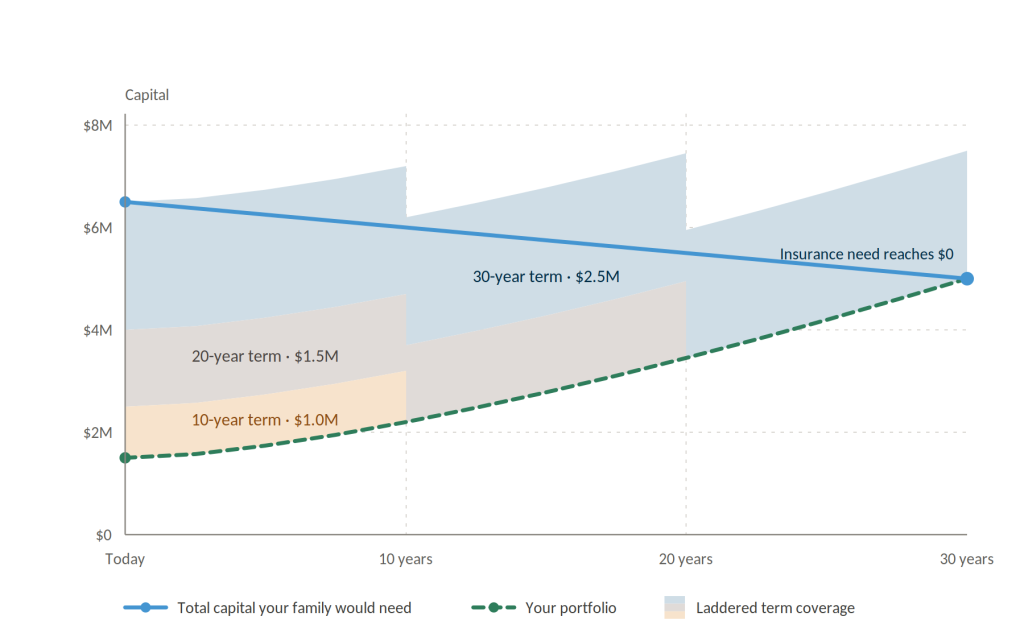
Hypothetical values shown for illustrative purposes only. Portfolio growth, capital needs, and insurance amounts are not based on actual client results and should not be viewed as projected or expected outcomes. See the end of this article for full disclosures.
The need declines. Each year, more wealth accumulates, debt declines, and there are fewer years of dependents ahead. At a certain point, the portfolio itself grows large enough to fund your objectives—and the need approaches zero.
That has a real consequence. Someone planning to work another 30 years who buys a 30-year policy sized to the gap that exists today will pay for far more coverage than they’ll ever likely need. Sizing the need at intervals lets us ladder term policies instead. By stacking coverage that steps down as the need does, we can achieve a lower lifetime premium. In practice, the ladder is built from the term lengths carriers actually offer.
Enough, not exactly enough
The approach we’ve outlined produces a recommended minimum level of coverage that clients can then implement by working with a broker. Because term insurance is inexpensive, it is often prudent to build in some breathing room rather than sizing coverage to the knife’s edge. Carrying a little more than the model requires costs a little money, while carrying too little can be financially devastating.
This isn’t a one-time exercise, either. Coverage should be revisited every few years, or whenever life changes. Examining the impact of a premature death is a topic that’s easily deferred to another day. Our objective is to make sure that this stone doesn’t go unturned.
CFA® and Chartered Financial Analyst® are registered trademarks owned by CFA Institute. Certified Financial Planner Board of Standards Inc. owns the certification marks CFP®. CERTIFIED FINANCIAL PLANNER™ and CFP® in the U.S., which it awards to individuals who successfully complete CFP Board’s initial and ongoing certification requirements. Investments & Wealth Institute® (the Institute) is the owner of the certification marks “CPWA®,” and “Certified Private Wealth Advisor®.” Use of CPWA®, and/or Certified Private Wealth Advisor® signifies that the user has successfully completed the Institute’s initial and ongoing credentialing requirements for wealth advisors. The ChSNC® is the property of The American College of Financial Services, which reserves sole rights to its use, and is used by permission.
This article is for informational and educational purposes only and does not constitute legal, tax, or financial advice. The figures shown in this article are illustrative and are not based on any assumed rate of return, rate of savings, inflation rate, or other calculated inputs, and do not represent the performance of any actual client account, investment strategy, insurance policy, or financial plan. Any portfolio values depicted are hypothetical and were created solely to illustrate the concept presented. The curves are intended solely to illustrate a general relationship that a family’s insurance need may decline over time as accumulated assets grow and should not be interpreted as an estimate of any client’s actual insurance need, portfolio value, or financial outcome. Actual investment results, asset growth, insurance costs, capital needs, market conditions, and other factors will vary and may cause outcomes to differ materially. No representation is being made that any investor will achieve results similar to those shown. The appropriate amount and type of life insurance vary by individual and depend on facts not reflected here. Laddered term structures shown are simplified and may not correspond to policies available for purchase. Past performance is not indicative of future results. The appropriateness of any insurance or investment strategy depends on an individual’s specific circumstances, objectives, risk tolerance, and financial situation. Readers should consult with qualified professionals regarding their specific circumstances.
Related Articles

July 28, 2026
Evacuation Order Level 3: Go Now! 3 Questions You Should Ask About Your Homeowner’s Insurance Before This Happens to You


July 17, 2026
A New Kind of Healthcare Advocate: Why Some Families Choose Private Health Management


July 10, 2026
Navigating Divorce: Financial Considerations